“a poem is alive. It is not untouchable. It is responsible.”:
An Interview with Gabriele Micozzi
Interviewed by Sara Judy, ballast co-editor
[SJ] First, thank you for sending these wonderful poems to ballast. They’re concerned with so many of the things that capture our attention as editors: experimentations in language, formal and visual play, a rare combination of earnestness and humor, what language can and can’t do, translations of languages, forms, and ideas, and what kind of attention poetry can encourage.
I’d like to ask you first about translation: as a writer in both Italian and English, how did you decide these “SIX WASTES” would be best presented in English? This question becomes especially interesting considering how often these poems are also concerned with linguistic loss in Italian.
GM: English, for me, is a lighthouse. Not the sun: a lighthouse.
It does not illuminate everything. It throws a beam, makes certain things visible from a great distance, and leaves others outside the light. A species can disappear once from a river, a forest, an island; it can disappear a second time if its loss never enters the language in which the world records what it considers relevant. Today, whether we like it or not, that language is often English.
I dislike this enough to want to use it. The IUCN classifies in English, the IPCC measures in English, and many figures acquire a second kind of authority after passing through that language. I do not think this is just. I think it is true. Retreating into dialect as protest would be a beautiful gesture and an almost perfectly invisible one. I would rather carry the dialect into the beam.
My grandmother used to say silenzio as if she were saying someone’s name. For her, the silence of a church was not the silence of a field; the silence after an argument was not the silence before a storm; the silence of a room where someone had died was something else again. Her Marche dialect held shades my English cannot contain. That is one of the paradoxes that interests me: the contemporary archive has a sophisticated vocabulary for recording disappearance and almost no ear for what disappears. My grandmother had the ear and no archive.
Had I written that loss only in Italian, I might have produced a lament — and Italians have a formidable tradition of lament; we have been practising at least since the fourteenth century. In English, inside a form, the loss changes temperature. It enters a language my grandmother did not speak, a box she would never have filled in. It feels crueler to me, and therefore more exact.
There is also a nearly technical reason. The officialese of your own language eventually becomes background noise: the air you breathe while waiting for your number to be called. In a second language it remains slightly foreign. Hazard class. Material. Quantity. The passive voice by which something is disposed of without anyone seeming to have disposed of it. That distance lets me hear the violence of the form again. A certificate, after all, has no mother tongue. It has a stamp.
Under all of this is the premise of the larger manuscript. I call it Biodiversità Letteraria, and I prefer to leave the phrase in Italian because it already demonstrates the problem: something shifts the moment you carry it across. A dialect word, an endemic species, a tiny craft, the unrepeatable way one person laughs can disappear through mechanisms that at least partly resemble one another: withdrawal of attention, loss of transmission, homogenisation. So a page can behave like an ecosystem. If one form takes all the light, the others do not germinate. Verse can stand beside data, a formula beside a haiku, a stage direction inside prose. English is one of the species hosted by that page. It is not my home. That is precisely why it makes me look back at home from outside.
[SJ] “Certificates” as I understand them are generally conferred on something completed, as evidence it was done (certificates of marriage, graduation, etc.) but these poems, even as they’re interested in what’s past, retain a sense that there may be new information, or amendments, to follow. You leave spaces blank, for example, to record “the last cricket heard in central Pesaro.” Do you imagine these poems being returned to, updated, revised, in the future?
GM: Yes. They are made to be reopened. Or perhaps to age well.
When I think of poems behaving like gardens, I am not speaking only metaphorically. I live in the Marche, where fields seen from the hills toward the Adriatic often look like gardens drawn by people who would never call themselves artists. Tractor furrows become lines, scratches, almost graffiti on the earth. One week they are green, then brown, then nearly black. The design changes and disappears because it is meant to grow something, not to be preserved.
Mario Giacomelli photographed this land for decades as body and writing: marks, folds, scars, transformations produced in part by agricultural work. I like to think certain farmers made land art all their lives without knowing it. Perhaps they made it better for that reason: it was not meant to last; it was meant to feed.
I would like a poem to carry the same responsibility. Structure, yes; but not a display case. A garden is not less designed because it changes. It is designed for change.
Extinction, in any case, is terrible material for certificates because it rarely has a clean date. The last individual often dies unwitnessed; the declaration arrives later, when someone stops looking. The phrase used for the Yangtze river dolphin — functionally extinct — has always struck me: certain enough to grieve, not quite certain enough to close the file. A certificate of disposal, by contrast, pretends there is an exact instant when the thing is over. The form begins lying before the poem has said anything.
That is why the blank for the last cricket heard in central Pesaro is not a graphic flourish. It may be the most honest field in the document. I do not know. Nobody knows. Nobody was assigned to know. That is the complaint: there is no office for the last cricket. The form admits its incompetence and hands the pen to the reader, who may be the only person still alive who remembers hearing one.
Your questions made this less theoretical. They made me reopen the certificates literally and correct what needed correcting. I have prepared one version in which some amendments remain visible and dated, like administrative scars, and a clean version in which the correction disappears into the document. I like both for opposite reasons. One shows that the text has a history; the other lets that history remain behind the page.
Since then I have believed more strongly that a poem that hosts reality should remain living matter. It can be studied, challenged, checked, corrected. Not because facts are flexible — for exactly the opposite reason. A text is alive when it accepts responsibility to something outside itself.
The day someone can fill in the date of that last cricket, perhaps the poem will be finished. Or perhaps it will simply have entered its next version.
[SJ] In these “WASTES” you employ a wide variety of different styles of font, spacing, and presentation of text, and yet the overall effect is harmonious. It brought to mind for me Robert Bringhurst’s The Elements of Typographic Style, and the idea that typography itself can be a poetic art (it strikes me that Bringhurst is also a poet and a translator). Can you describe your formal process around typesetting these poems? What is the relationship for you between typography as a form and the project as a whole?
GM: The Bringhurst comparison is generous, but the word that interests me most here is not beauty. It is authority. Typography can make us believe before we have understood.
A certificate persuades with the eye. The rule, the leading, the small caps of the issuing body, the monospace of machine-filled fields, the dot leaders carrying a name toward its number, the empty space where we expect a stamp: we recognise authority before we read. The dot leader may be my favourite thief. It promises that the thing on the left and the number on the right belong together. It never explains why.
My process sometimes begins with the form and sometimes with the sentence. If I begin with a grid, language has to survive inside it: the width of a column decides where a line can breathe. At other times I begin with a fragment and build the form that will best protect it — or betray it. The diminishing SILENZIO was not written first and typeset later. It was born on the page. You cannot really read it aloud: the disappearance of the word for silence takes a shape the voice cannot fully possess.
I have made calligrams since I was a boy. The page became a surface for me early, not merely a container.
Then there is my working life. For years I have also lived inside companies, universities and business schools. I use slides, charts, matrices, KPIs. Sometimes I put a poem inside those forms. Not to make management poetic — that would be a punishment for both poetry and management — but to see what happens when a form receives a content it did not expect.
In the classroom the scene is often similar. In the middle of a day on strategy, a poem appears. At first certain managers look at me as if I have opened the wrong file. Someone stops typing. Someone else looks up. Then, not always but often enough, the temperature of the room changes. Poetry has entered a place where it was not invited, and corporate language has to share the room with something it cannot immediately convert into a procedure.
The same obsession led me to create Mental Imprint. I did not want “another literary prize,” but a small cultural challenge: to encourage narrative biodiversity inside organisations. Alongside poetry, fiction and hybrid work, the prize asks us to look at ESG reports, social reports, strategic plans, product sheets and other corporate documents as possible narrative objects. Not because a balance sheet should pretend to be a poem. Because a balance sheet is still written by human beings for other human beings. It can be precise without losing its voice; simple without becoming anonymous.
The question is almost childish: do companies still know how to write?
For years we simplified in the name of efficiency: slides, bullet points, formulas, keywords, templates. Then artificial intelligence arrived — an extraordinary tool that I use and study too — but one that can accelerate an existing tendency if we hand over the choice of voice as well. While I was answering these questions, on 24 August 2026, Nature Human Behaviour published a study by Zhivar Sourati and colleagues across more than 880,000 texts in seven datasets: in texts polished or rewritten by LLMs, core content tended to remain, but styles converged and the variance of writing complexity fell by 21–50%, depending on dataset and model. That does not mean AI makes everybody identical. It means the risk of homogenisation is measurable.
For me, the problem is not that machines can write. The problem begins when human beings stop choosing how they write. Mental Imprint grows from that concern too: to defend a little narrative biodiversity inside places that risk speaking with the same voice.
If I pull the thread backwards, though, I discover that this contamination is less new than I would like to imagine. I trained at ISTAO in Ancona, inside a culture deeply marked by Adriano Olivetti. Olivetti brought writers and intellectuals into real roles inside the company: communication, social services, personnel selection, organisation. Fortini and Giudici also collaborated on advertising copy; Ottieri selected workers for Pozzuoli; Volponi moved through the company as both writer and executive. This was not culture hung on the factory wall. It was the idea that a factory also produces language and imagination.
Then there is Lamberto Pigini, another figure from the Marche. In the 1950s he began by creating vocational training centres for young people affected by the economic crisis around Castelfidardo; from there came training, language teaching, printing, publishing and enterprise. In the early 1980s ELI even published Disney characters in Latin — Michael Musculus, Donaldus Anas. I like Mickey Mouse used as a Trojan horse for an ancient language. A popular form can carry a language into a place that the language, by itself, might no longer be able to enter.
Pull the thread further back and you reach Dante. The Commedia is also an enormous classification machine: circles, ditches, categories of damage, penalties, a poet moving through the archive and taking notes.
Then Fabriano, about forty kilometres from my home: paper, watermarks, a mark of authority that appears only when you change the angle of the light. And that paper was made from rags. The document was already made of waste before anyone wrote on it.
In Recanati there is still a workshop working slowly with calligraphy, engraving, parchment and certificates. My Bureau issues forms rapidly, in monospace. Not far away, someone still does the opposite.
And then neorealist cinema, which reminds me to use the real street, look at what seems unimportant, refuse the easy resolution. The man who repaired umbrellas in our piazza belongs to this genealogy more than any theory does.
In the end, all of this becomes an ethical question. The same typographic grammar that certifies a loss can sell a mortgage, bury a side effect, make a balance sheet look clearer than it is. We are taught to distrust a word that lies; almost nobody teaches us to distrust a lying margin.
The curious thing is that typography may be the only part of these poems that requires no translation. A rule is a rule in every language.
[SJ] These poems are also interested in statistics and records. This is part of their bureaucratic logic, but – and I may be wrong! I would love to be wrong – I imagined some of these numbers and statistics are more felt than factual. Am I wrong? Are the numbers “real”? In any case, how did you go about identifying the information you chose to include here? What is your approach to the “truthiness” of these poems?
GM: This question embarrassed me in the useful way. It made me stop defending the work and start looking at it again.
The first thing I understood is that the numbers in Six Wastes do not all come from the same place, and they do not all ask to be believed in the same way. Some come from scientific research and institutional sources. Others come from direct research I conduct professionally and from observatories I activate, including in my role as president of Marketing Associati. Others are estimates. Others are quantitative intuitions — what I call Anthropo Indicators: poetic attempts to give a measure to things no statistical institute is likely ever to measure, the threshold of grief, the weight of an absence, how much memory disappears with a word. Then there are blanks, and quantities explicitly declared unmeasurable.
The sequence, in the form I first sent you, did not always mark these categories clearly enough. Your question made that visible to me. That is already an important consequence of the interview: not to invent a retrospective justification, but to make the nature of the numbers more legible as the work develops.
Not every number has to make the same claim. But every number should declare what kind of thing it is.
And I do not use numbers only to inform. If I had wanted to explain, document and close the argument, I would have written an essay. I write essays, and that is exactly what they are good at. In a poem, a datum has another job as well.
I want it to do three things.
First: slow the mind down. Move the reader from fast thought to slow thought. A number looks finished: 147 minutes a day, eleven days in a lifetime, thirty-five decibels. Typography makes it look even more finished. I want it to become a small obstacle instead: wait.
Second: create doubt. Who measured this? How? When? What exactly is being measured? What is missing? Doubt, here, is not the enemy of knowledge. It is often the beginning of it.
Third: create the desire to go further. Find the source. Compare another study. Ask what other data would be needed to map the existing world more adequately. A good datum should not always close a question. Sometimes it should multiply it.
So I would no longer ask a number to be incontestable. That would be a strange ambition even for science. I ask it to be accountable: sourced when a source exists, marked as an estimate when it is an estimate, admitted as an intuition when it is an intuition, left blank when nobody knows, corrected when better knowledge arrives.
There is also an emotional reason. We are exposed to enormous quantities of images, tragedies, numbers and notifications. We can know a great deal and feel very little. I use a clinical word cautiously here: alexithymia means difficulty identifying and describing emotions. When I speak of a kind of “cultural alexithymia,” I mean it metaphorically: a condition in which we see almost everything, measure almost everything, and risk becoming impermeable. Indifference does not always come from ignorance. Sometimes it comes from excess.
I want some numbers to act as a small impact against that impermeability. They should not tell you what to feel. They should make it harder, for a few seconds, to feel nothing.
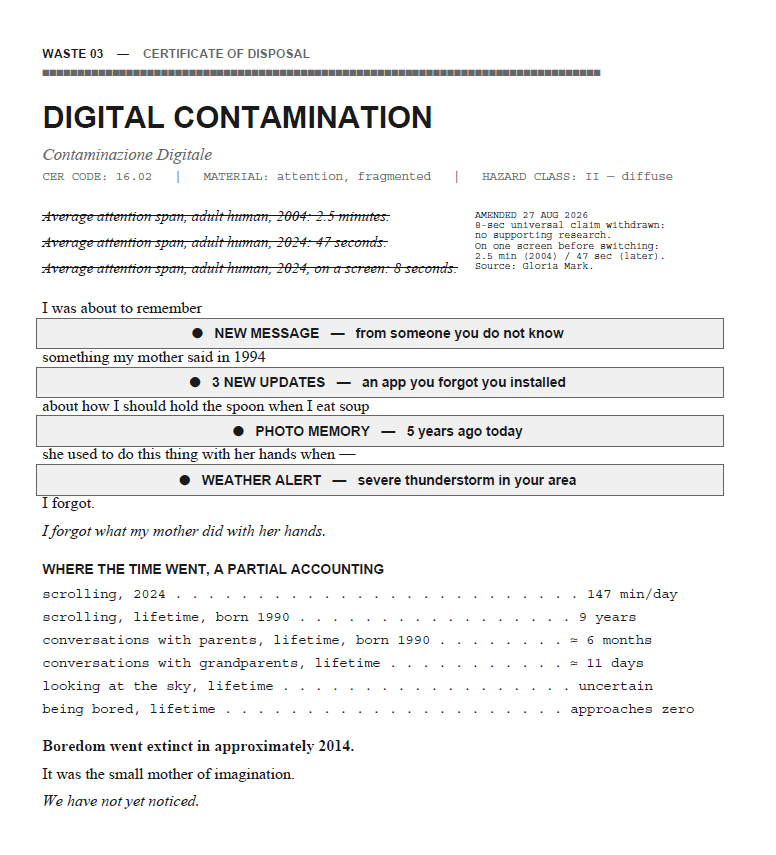
Your question forced me to do exactly that. I went back to the sources and found several entries that needed correction. The familiar eight-second screen-attention claim, which I had carried in good faith for years, did not hold up as a universal measure of human attention. Gloria Mark’s work supports something different and more precise: the average time spent on one screen before switching was around two and a half minutes in 2004 and, in later studies, about forty-seven seconds. I also found a small date beside Leopardi that needed correction. [ed note: a visibly corrected version of “Digital Contamination” appears in-line with this interview]
There is an almost comic moment in fact-checking when you keep clicking backwards, hoping the source will eventually become better. Mine did not.
I thought I was auditing the world; for an afternoon, the poem audited me.
It was useful. The poem did to its author what I hope it can do to a reader: it made me stop.
I sometimes do something related when I teach, but the contract is different. I deliberately place one error inside a lesson and wait. Most people continue. Occasionally someone interrupts me. That moment interests me enormously: knowledge has become judgement. But the distinction matters. In a classroom I am there to close the loop. The mistakes I found in the poems were simply mistakes.
Perhaps that is also what I mean when I say a poem is alive. It is not untouchable. It is responsible.
When I was a child, this obsession with numbers was much less serious. At six I asked my father for two presents: a telescope and a geology manual. I wanted the sky and I wanted the list. Later I kept small private indices: ice creams per summer, smiles counted around a table, which summer had been the best and by how much. At nine I was already making Anthropo KPIs without knowing it and, more importantly, without the melancholy.
For me, counting something is not necessarily the opposite of loving it. It can be one way of looking at it long enough.
The figure is not the answer. It is the point at which I want the reader to stop.
[SJ] Related to the bureaucratic logic, and coming back to my first question about translation, I wonder: is English more bureaucratic than Italian? Or are their bureaucracies different, and, if so, in what way?
GM: I think the two bureaucracies commit different sins: Italian makes you wait; English makes you fit into a box.
In Italian administrative language I still hear the ecclesiastical chancery and legal Latin. Before telling you what will happen, it wants to tell you under which provision, pursuant to which article, given that, having regard to, considering that. It absolves or condemns, but first it builds a corridor of subordinate clauses. It uses many words partly to make it difficult to identify who, exactly, decided. Reading certain Italian public notices is like listening to someone clear their throat for a paragraph and a half.
In administrative English I hear the commercial register more strongly: state, classify, invoice. A box, a signature, a date. Hazard class. Material. Quantity. It is a language that wants to know what is in the hold and how much it weighs.
For my certificates I needed a language capable of closing. In Italian, before declaring a cricket extinct, we would probably cite three previous regulations; the cricket would die in the meantime.
But I do not want to flatter English. The two evasions are simply different. Italian can evade through elaboration; English can evade through category. Put a living thing in a field marked MATERIAL and you have reduced it before you have even described it.
Perhaps that is what unsettles me most about the present: much destruction is no longer absolved or condemned. It is recorded.
And I no longer know which language is more frightening: the one that will not stop talking about your death, or the one that has already prepared the box in which to enter it.
[SJ] Last, I’m going to steal a question that my co-editor, Jacob Schepers, asked when he interviewed the poet Dennis Hinrichsen: What’s your take on the state(s) of poetry right now? In particular, what do you find exciting about it?
I’d also be interested to hear about how you’re thinking about poetry’s relationship to the climate crisis. I know you also write experimental fiction and essays; is poetry more, or less, or equally suited to the moment we’re in?
GM: Whenever I hear the phrase “the state of poetry,” I think poetry is fortunate not to have a state. It has weather instead: local, unstable, full of small disturbances that begin far from the centres and occasionally change the air.
That is what excites me. Poetry has an almost absurd economy, and because of that it retains a freedom other forms find harder to afford. So much of its energy lives in small, free, stubborn journals kept alive by people reading submissions after their day’s work. Like ballast. The economics are catastrophic; the side effect is that nobody asks a poem to test well in a focus group.
Translation also feels particularly alive to me at the moment. For anyone writing between languages, that is a piece of historical luck.
Perhaps for the same reason I like taking poems outside places that have already agreed to be poetic. I use them in classrooms. I read them in the street. There, nobody has bought a ticket and nobody has to prove they know who the poet is. Someone walks past, slows down, stays for thirty seconds, or leaves. I like that mutual freedom.
Poetry can join people before it explains anything. Sometimes, stranger still, it explains something without having explained it. It does not hand you a thesis. It leaves a sentence, a rhythm, even an irritation. Meaning may arrive hours later while you are doing something else entirely. It is one of the few languages I know that can keep working after it has stopped speaking.
With climate, the problem is almost the reverse: we have an enormous quantity of explanation and a much smaller emotional capacity. The crisis is statistical; the human mind is anecdotal. Nobody weeps over a decadal average. We can grieve one animal and remain almost untouched by ten thousand. Institutions are forced to report the crisis in the register we are worst equipped to feel: series, curves, scenarios, percentages.
If all I wanted was to explain climate, here too I would have written an essay. Poetry interests me because it can place the datum and the body on the same line without asking permission. It can make a percentage weigh something for a moment.
I do not think poetry will save the planet. I distrust saving powers, especially when we award them to the thing we ourselves do. I also write fiction and essays, and I work with a hybrid form I call FilmBook, where verse, verified data, prose, image and stage direction can share the page like different species in the same habitat. None of these forms will save anything by itself.
But a poem can do something smaller and perhaps more necessary: make a number briefly unbearable and then let you carry it away.
About twenty kilometres from where I write, two centuries ago, a provincial boy gave a poem almost every Italian still knows a title naming a quantity that cannot be measured: L’infinito. Giacomo Leopardi needed a real hedge, on a real hill, blocking the horizon. The limitless became available to him because something ordinary stood in the way.
That idea stays with me.
Today, from those same hills, the sky is not quite the sky he wrote from. Recanati is also home to a major architectural lighting company founded in 1959 and involved, since the 1990s, in campaigns against light pollution. The town of L’infinito therefore designs the light that can erase the stars and, at the same time, technologies and arguments for reducing it.
The contradiction is too interesting to flatten into an accusation. The same hands do both; in a broader sense, one of those hands is mine too.
All I can do is place that contradiction inside a certificate and let the reader tilt it toward the light.
In Six Wastes, Leopardi’s hedge is the space left blank.