Dialogue:
Allegra Wilson & Kelly Gray
Allegra Wilson on Kelly Gray’s “West County”
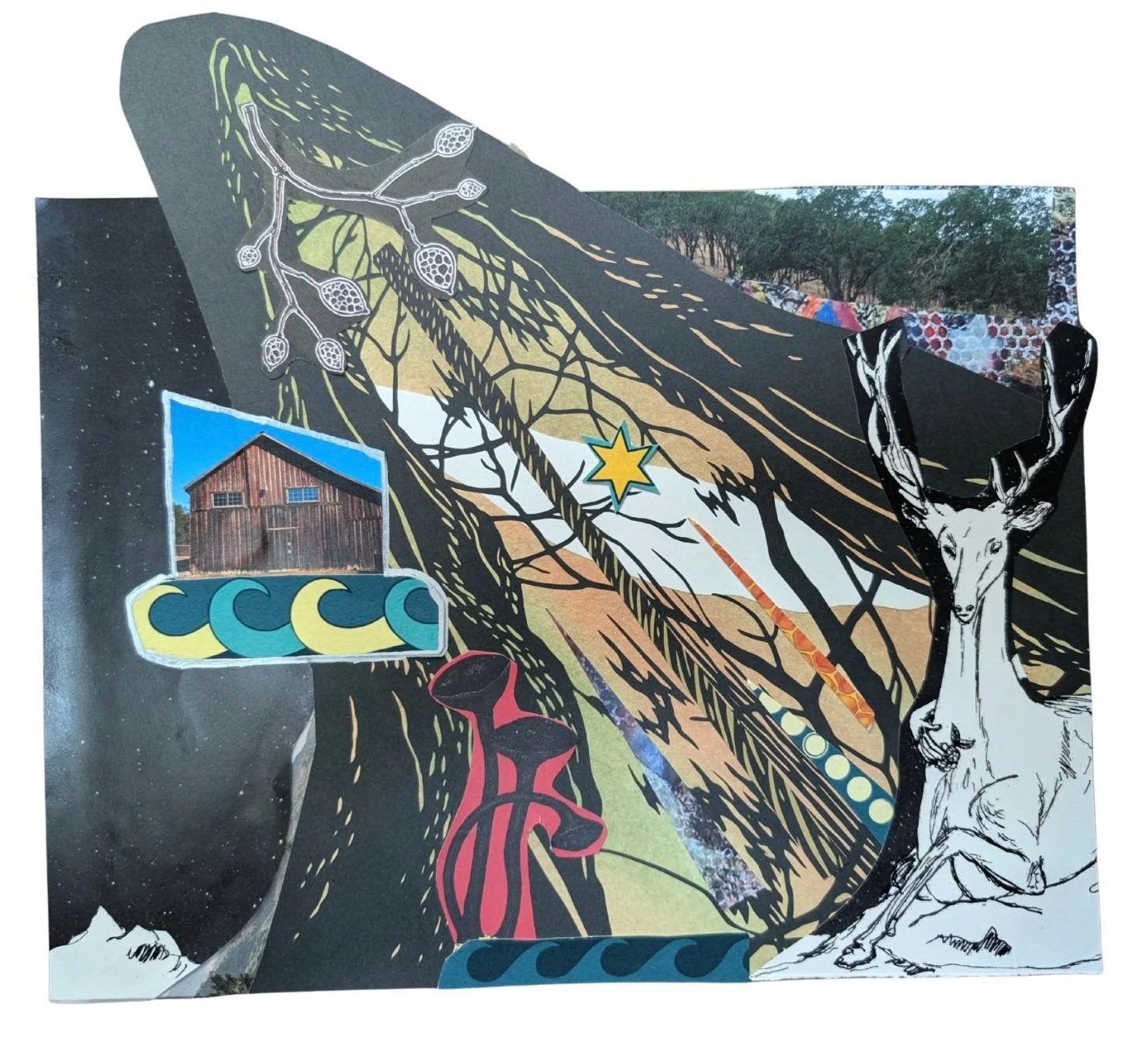
I’ve borrowed these images, tried to make a picture of a portal. I couldn’t find enough cows or meat. I couldn’t find enough blood. I attempted to mimic the splicing of time, the misfit layered landscape. The uneven, ankle-twisting texture of the earth. The truth of the story, even as it contains at least one admitted lie. This is vivid description of a landscape overrun with ghosts; where the images within the poem that sound most fantastical may be the most fact-faithful. Poem as reality collage, otherwise known as dream. A surreality made up mostly of the facts on and of the ground. A two-dimensional flat form that takes the reader through a portal, to a fully realized place called West County.
Within one poem we get a history (“Seven decades ago, there were special sticks for killing/frogs”) and a future (“In one decade, my husband will be in love/with another woman”). Layer after layer, a world of images pasted together so that you can live in it; bread that smells like “the tender side of men” and the taste of grilled “bitter leaves of endive.” There is a dense population of human (Johnny, Owen, the farmer, the girl with the berry cheeks, the old woman) and non-human (cats, deer, cows, frogs, eel) life which provides a counterpoint for death after death, starting with the “vulture on the ground, the deer turned open like a valentine” and ending with unidentified roadkill. Birth is only imagined: “Imagine life starting as the world cracking,/not the hot flesh parting.“ The land itself is an active participant, with trees that “have taken flight” and fog that commands (“The fog says take off your blouse”).
Back through the portal, we return to where we are from. I respond with quotations and images that aren’t my own. Pasting disparate pieces together, and thinking about the “you” addressed in the poem, who “didn’t want to steal everything.”
Kelly Gray on Allegra Wilson’s “victory ballad of sacred queers & perverts”
When Mud Was Blood, a Mini-Review by Kelly Gray
Lately, I have wanted to be thrashed by poetry. I have found myself numb by the horrors of the world, specifically how finite loss feels. How locked in this all feels. I find myself drawn to language that works to erode linear time by sitting in a spectacle, that has found its niche between hallucination and the liminal. I want to be reminded that our beloveds return is possible, that through language we can travel to those who need us, and be embraced by those who we need. I want to be unhinged from now so that I too can return anew. I found these possibilities in the backwards and forwards momentum of Allegra Wilson’s poem, “victory ballad of sacred queers & perverts.”
Wilson slings you backwards before she brings you forward by way of synaptic leaps through history. In just one poem, she weaves in queer solidarity so rich that even the word pervert is reclaimed and made edible. From the onset, we find ourselves stationed looking backwards in the first five lines of anaphora, We were. This chant intoxicates the listener, loosens up the body, and readies the reader for lessons in time travel.
The work to hold up the altar is central to the poem and is reflected in the work of metaphor, which holds up the poem itself. Ethereal yet gritty lyricism offers up simple joys in mandarins and lace, but then Wilson begins to add mud to the poem. Mud, the softening of clay and silt by water. The softening of trauma, of exposure, of silence. When we are feeling most soft, the poem pivots to swing forward to present time. An eruption takes place: Now our rings five times. The joy of costume around the neck of the enemy. I suddenly realize that we and our is for me too, I am connected through community survival and by familial lineage because there are children, parents, caretakers, those tending the altar, and those tending the enemy as well. Now our rituals expose gods and clot mud. Yes, there are others who wish to hurt us, but I am being held tenderly, fiercely, within.
I want poetry that does not need to tell my everything. There are enough experts and explainers in this world. In this poem, there is space. On the page, but also off the page. Wilson generously trusts the reader to take this romp with her and fill in the blanks. Take a little time to dream, the language beckons with sights, sounds, kisses on knees. It is not till the end that we receive a subtle affirmation that yes, we are in proximity to a great explosion. Yes, we are queer. Yes, this was happening then, and this is happening now. We, as in all of us, climbing in and out of the sea.
For each issue, ballast asks pairs of poets to read each other’s work and respond in some way. We hope these dialogues will sound the resonances contained within the issue as well as serve to foster a sense of interconnection and community among our authors.
If you’ve been published in a previous issue of ballast and would like to participate in a dialogue, please reach out to our editors at ballastjournal@gmail.com.