Editorial Introduction
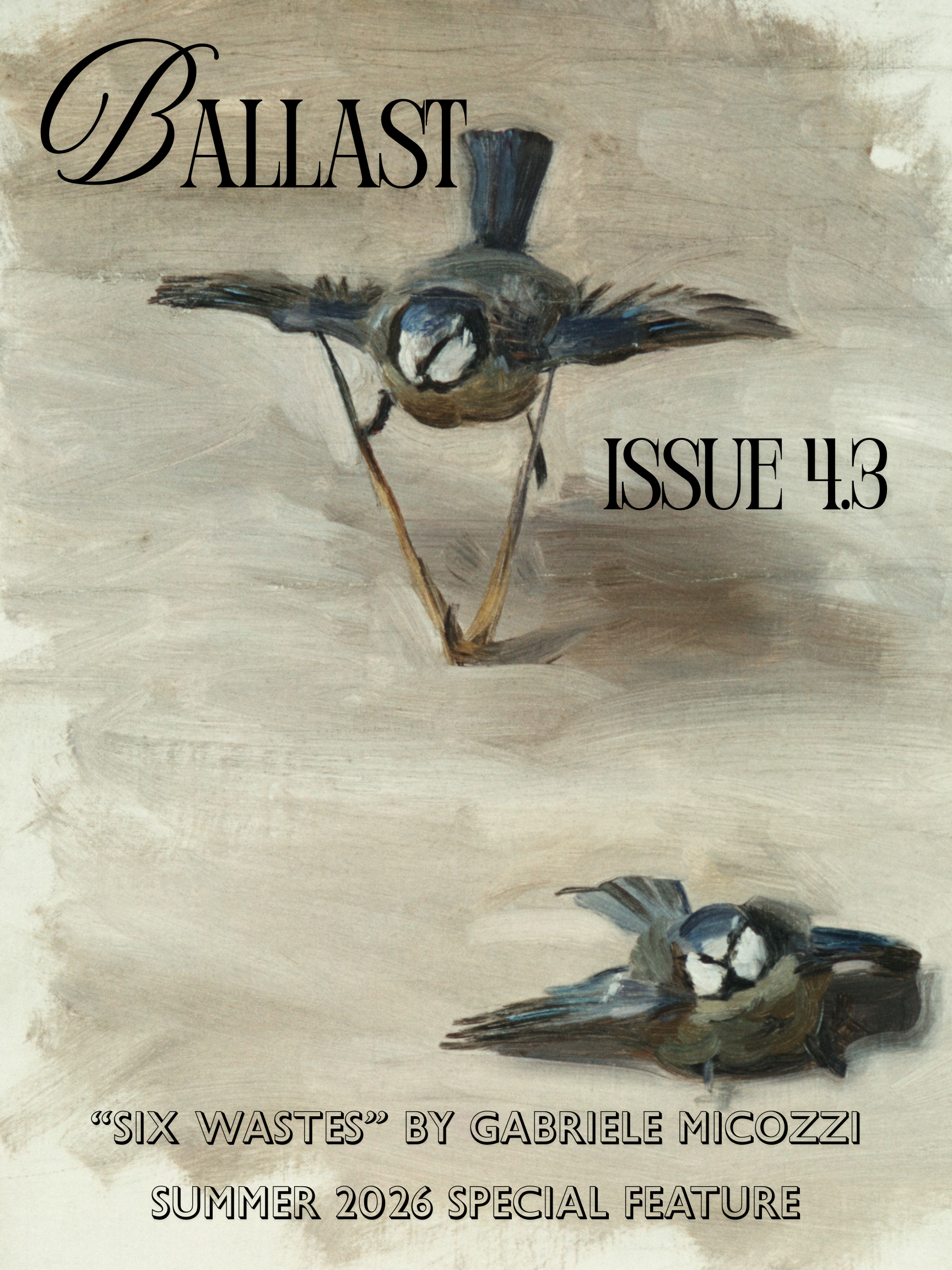
ballast 4.3
We went out on a limb for ballast 4.3.
We welcomed our first special issue, an individual portfolio, of Italian writer Gabriele Micozzi’s series “Six Wastes.”
These “Wastes” constitute a sequence of six certificate-poems from Micozzi’s unpublished manuscript-in-progress, Cronache dall'Antropocene. Micozzi described the series to us, saying “The poems map the contemporary landscape of anthropogenic damage through six bureaucratic categories: acoustic pollution, light pollution, digital contamination, food industry, biodiversity loss, and linguistic pollution. Each is formatted as an administrative document — a certificate of disposal — issued under the imagined authority of the Anthropocene Bureau of Damages.” This is dystopian lyric, weaponized bureaucracy, interventionist poetry. This is the kind of writing the world may very well need right now.
These poems resound a vital, urgent call of alarm, each one a necessary figure for the series to hold up as six wastes, six extinctions, amid our own ongoing sixth extinction (to borrow a term from writer Elizabeth Kolbert). At ballast, Sara and I wanted to honor the space that Gabriele clears in his certificate-poems, rife with industry speak and bureaucratic factoids about human-caused environmental harm and the losses that mark this ongoing — and unlikely to be reversible — decline.
In his submission, Gabriele shared that “The sequence treats biodiversity as encompassing not only the extinction of species but also the disappearance of singular biographies — the dialect word, the small craft, the unrepeatable gesture of a single life. The thesis is that taxonomic and biographical losses are governed by the same mechanism: the withdrawal of attention.” He holds both the parts and the whole in this tension, lamenting species decline and individual loss in a wide-ranging, far-reaching act of grief.
And if the withdrawal of attention is, as Micozzi suspects, to blame for glossing things over, then lets sit with that for a long moment. Our attentions spans as in demand and as monetizable as ever, it felt fitting, in other words, to slow down and sit within the annals of Micozzi’s Anthropocene Bureau of Damages. Damages, wastes, pollutions, extinctions—each word connotes for me, writing this at the tail end of summer, a series of endings, a coming harvest, dare I say a reaping. Can poetry be space to bear witness and catalog this end? Can poetry recover more than the imagined entity of the Anthropocene Bureau of Damages? Is poetry simply this Bureau by another name? Micozzi’s work is one entry on that ledger, one answer to those questions. Sit with these wastes and ponder with us on the trash heap.
Thanks for reading and thinking with us.
—Jacob, for ballast